The Injury Prevention Checklist: 10 Moves Every Lifter Needs To Stop Pain Before It Starts
19 days ago
5 minute read.

Walk into any corporate gym at 7 am and you will see the same pattern. Focused professionals pushing through reps before meetings begin. Deadlines in one hand, dumbbells in the other.
But here is the uncomfortable truth. Most lifting injuries do not happen because of heavy weights. They happen because of skipped basics.
Tight hips. Weak stabilizers. Poor mobility. No warm up.
Pain does not suddenly appear one morning. It builds quietly. Then one day your shoulder protests during a press. Your lower back tightens mid deadlift. Your knee flares up during lunges.
Fortunately, most of these issues can be prevented.
After years of observing workplace fitness programs and strength enthusiasts, I have seen a simple pattern. The lifters who stay pain free are not necessarily the strongest. They are the most prepared.
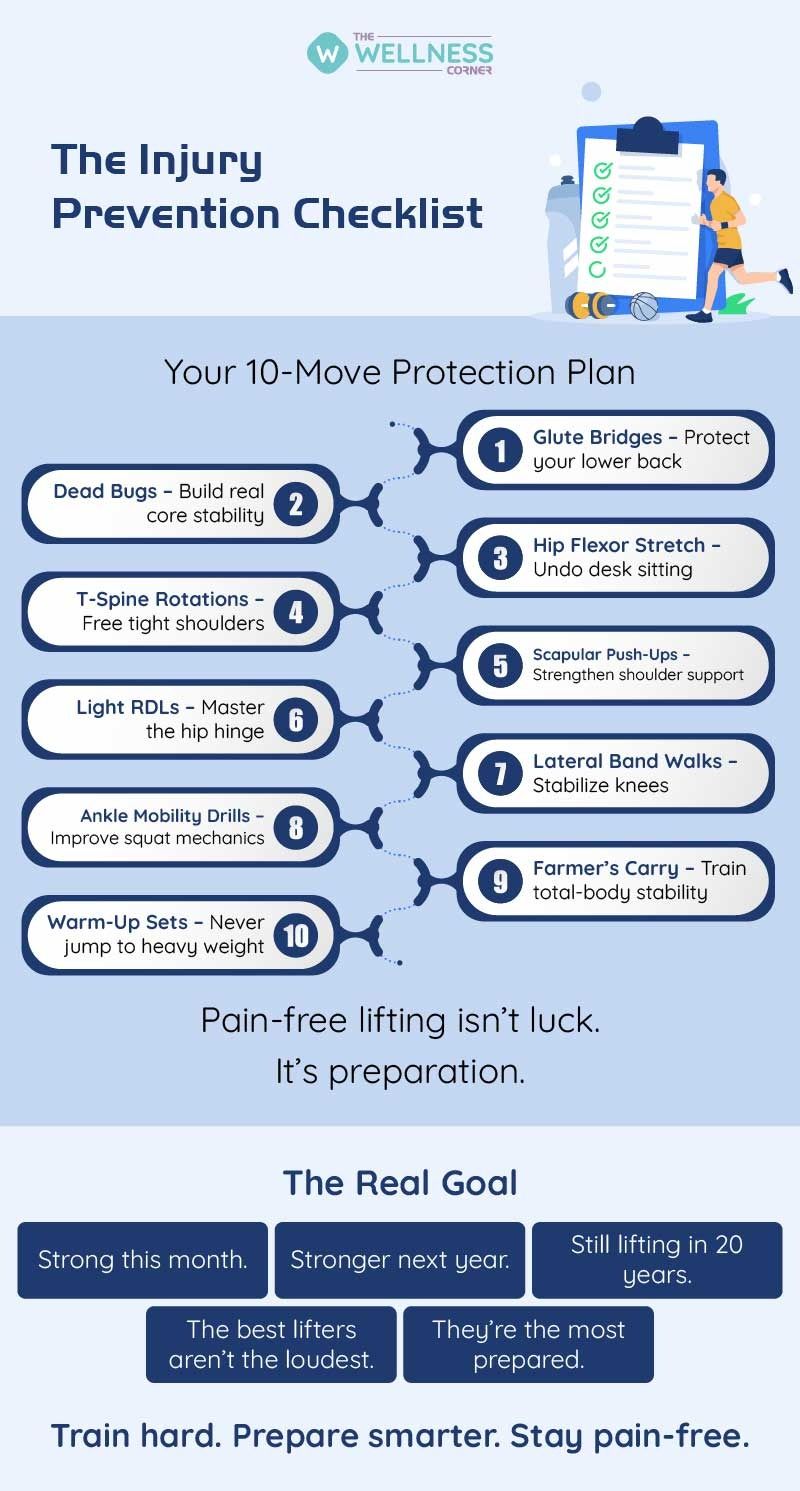
Here is your practical injury prevention checklist. Ten essential moves that protect your joints, strengthen your foundation, and keep you lifting for the long term.
Also Read: Keys To Training Safely & Lifting Heavy At Home Without A Spotter
Why Injury Prevention Is A Performance Strategy?
In corporate life, downtime is expensive. The same applies to your body.
An injury does not just interrupt workouts. It disrupts sleep, productivity, mood, and confidence. When movement hurts, stress increases. And stress affects everything from decision making to recovery.
Prevention is not a luxury. It is a strategy.
Think of these ten moves as insurance for your strength.
1. Glute Bridges: Protect Your Lower Back
Weak glutes force your lower back to compensate during squats and deadlifts.
Glute bridges activate the posterior chain and teach proper hip extension. When your glutes fire correctly, your spine stays supported under load.
How to do it?
Lie on your back, knees bent. Push into your heels and elevate your hips so your body forms a straight alignment. Pause, squeeze, lower slowly.
Two sets of 12 controlled reps before lifting can dramatically improve stability.
2. Dead Bugs: Build Core Control That Actually Transfers
Traditional crunches do little for lifting safety. What you need is core stability.
Dead bugs train your core to resist movement while your limbs move. This skill protects your spine during heavy compound lifts.
Lie on your back, arms up, knees bent. Extend opposite arm and leg slowly while keeping your lower back pressed into the floor. Alternate sides.
Controlled movement matters more than speed.
Also Read: Strengthen Your Core to Manage Your Emotions And Gut-Brain Connection Effectively
3. Hip Flexor Stretch: Undo The Desk Damage
Sitting shortens hip flexors. Tight hip flexors pull on the lower back and disrupt squat mechanics.
A simple kneeling hip flexor stretch restores length and reduces strain.
Hold for 30 seconds each side. Breathe deeply. Do not rush it.
For professionals who sit long hours, this is non negotiable.
How to do?
Step one foot forward into a half-kneeling position. Gently shift your hips forward while keeping your chest tall and core lightly engaged. You should feel a stretch in the front of the back hip.
4. Thoracic Spine Rotations: Free Your Upper Back
A tight upper back places unnecessary stress on the shoulders.
Thoracic mobility improves pressing form and reduces shoulder impingement risk.
In a side lying position with knees bent, rotate your top arm open toward the floor behind you. Keep hips stable.
Eight slow reps per side can improve overhead mechanics instantly.
5. Scapular Push Ups: Strengthen Shoulder Stability
Shoulder pain is one of the most common lifting complaints.
Scapular push ups train the small stabilizing muscles around your shoulder blades. Strong stabilizers reduce stress during presses and rows.
In a plank position, keep arms straight and move only your shoulder blades. Allow your chest to lower gently, then press the ground away from you.
Quality beats quantity.
6. Romanian Deadlift With Light Weight: Groove The Hinge Pattern
Many lower back injuries happen because lifters bend through the spine instead of the hips.
Practicing a light Romanian deadlift reinforces proper hip hinge mechanics.
Focus on pushing hips back while keeping the spine neutral. Feel tension in your hamstrings.
Mastering this pattern protects you when the weight increases.
Also Read: Why Your Lower Back Hurts After Deadlifts? (And The Simple Form Fix You’re Missing)
7. Lateral Band Walks: Bulletproof Your Knees
Knee pain often stems from weak glute medius muscles.
Lateral band walks activate these stabilizers, improving knee alignment during squats and lunges.
Position a resistance band just above your knees or around your ankles. Take small, controlled side steps while maintaining tension.
Your knees should not collapse inward. This one detail prevents countless issues.
8. Ankle Mobility Drills: The Forgotten Joint
Limited ankle mobility changes squat depth and increases knee strain.
Simple ankle rocks or calf stretches improve range of motion.
Stand facing a wall. Drive one knee forward toward the wall while keeping your heel down. Repeat slowly.
Healthy ankles create better lifting mechanics from the ground up.
9. Farmer’s Carry: Train Real World Stability
The farmer’s carry strengthens grip, core, and shoulder stability simultaneously.
Pick up moderate weights in both hands and walk slowly with an upright posture.
This move teaches total body tension and balance. It translates directly to safer heavy lifting.
Also Read: Effects Of Bad Posture
10. Controlled Warm Up Sets: Your Built In Safety Net
The final item on this checklist is not a stretch. It is discipline.
Never jump straight to working weight.
Gradually increase load through progressive warm up sets. This primes your nervous system and reveals stiffness before it becomes pain.
Rushing is the fastest path to injury.
The Corporate Athlete Mindset
If you lift while managing a demanding career, you are a corporate athlete.
Your recovery resources are divided between mental stress and physical stress. That makes preparation even more important.
Injury prevention is not about fear. It is about longevity.
You want to be strong not just this quarter, but for the next twenty years.
Also Read: Ergonomic Tips To Prevent Injury
Building This Into Your Routine
You do not need an extra hour.
Select five of these movements and perform them in 10 to 12 minutes before your main lifts. Rotate the others through the week.
Consistency is more important than intensity.
Think of it as brushing your teeth. You would not skip that for weeks and expect no consequences.
The Real Win: Pain Free Progress
When your body feels stable, you lift with confidence.
When you lift with confidence, performance improves.
When performance improves, motivation stays high.
Injury prevention creates a positive feedback loop. Pain creates the opposite.
Choose wisely.
Frequently Asked Questions
1. Do I need to do all ten exercises every workout?
No. Choose the ones that address your weak areas and rotate them through the week.
2. How long should this checklist take?
Around 10 to 15 minutes. Think of it as preparation, not extra work.
3. Can beginners use this checklist?
Absolutely. In fact, beginners benefit the most because they are building movement patterns from the start.
4. What if I already have pain?
Ongoing pain should be assessed by a qualified healthcare provider. These exercises support prevention, not diagnosis.
5. How soon will I notice a difference?
Many lifters feel improved mobility and stability within a few weeks of consistent practice.
Strong Today. Strong Tomorrow.
Lifting is not just about muscle. It is about movement quality, joint health, and resilience.
The smartest lifters in any corporate gym are not the loudest or the flashiest. They are the ones who prepare quietly and train consistently.
If you want structured guidance that blends strength training, mobility, mental wellbeing, and sustainable health habits, The Wellness Corner can help.
At The Wellness Corner, we design holistic wellness programs that support professionals both inside and outside the gym. From expert fitness guidance to nutrition and mental health support, our integrated approach helps individuals and organizations build strength without burnout.
Because true strength is not just how much you lift.
It is how long you can keep lifting without pain.
Leave a Comment

Sign-Up Now & Unlock
₹100 Cashback
Recently Published
Related Articles


Health Checks @ Home
Service
Explore



Follow us on:


© 2026 Truworth Health Technologies Pvt. Ltd.