No-Mind Meditation: Understanding The Emptiness Beyond Mental Clutter
1 day ago
5 minute read.

Most people spend their entire day thinking.
Thoughts about work, relationships, deadlines, responsibilities, fears, notifications, conversations, and future worries constantly compete for attention. Even during moments of rest, the mind often continues running in the background.
This nonstop mental activity can become exhausting.
Many people describe feeling mentally “full” even when physically resting. The brain rarely gets a true pause.
This is one reason meditation practices are gaining attention worldwide. Among them, one concept often sparks curiosity because of its unusual name:
“No-mind meditation.”
At first, the term sounds confusing.
Does it mean stopping all thoughts completely? Does it require emptying the brain entirely? Is it about becoming emotionless or detached?
Not exactly.
No-mind meditation is less about forcing the mind into silence and more about creating space between awareness and constant mental chatter.
It is not about becoming thoughtless.
It is about becoming less trapped by every passing thought.
Also Read: 6 Life-Changing Benefits Of Daily Meditation You Might Be Overlooking
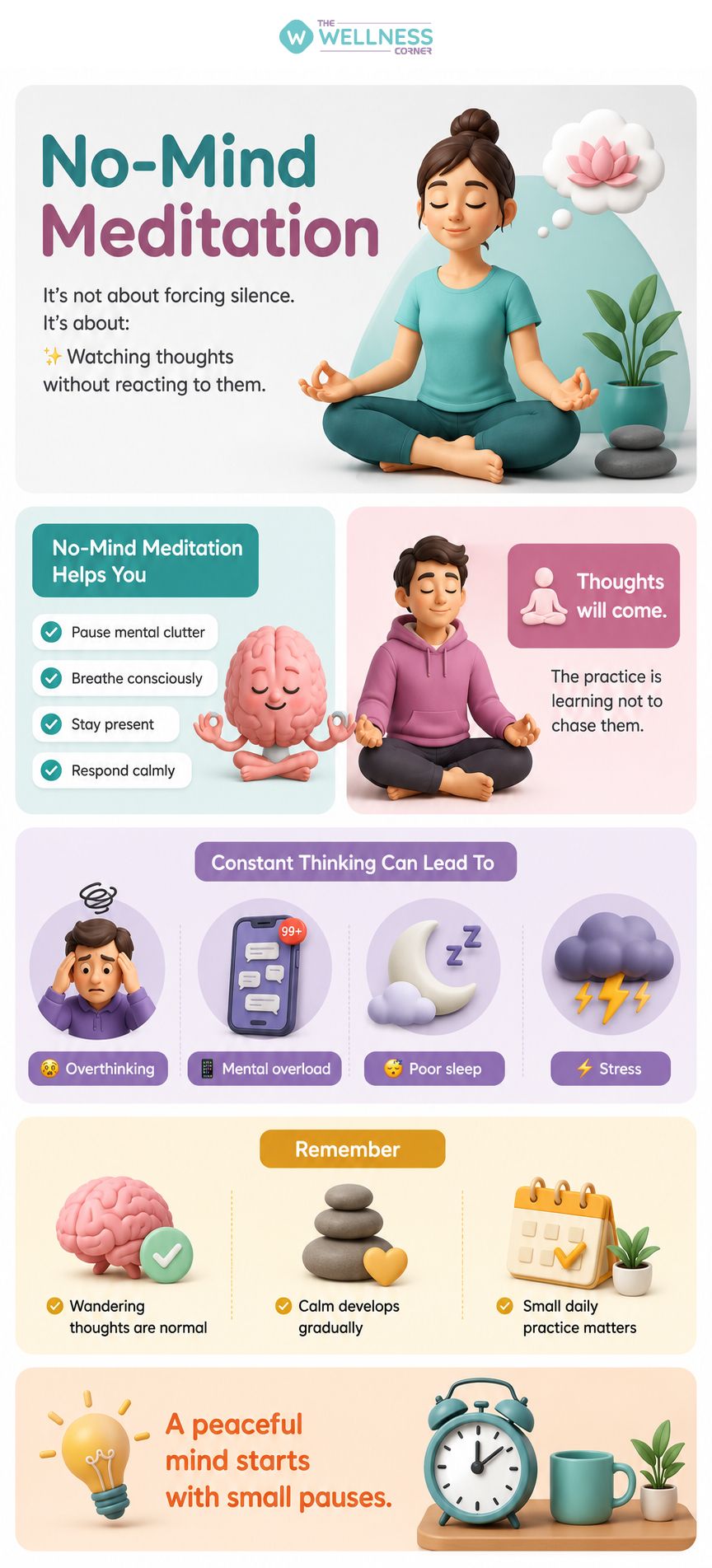
What Is No-Mind Meditation?
No-mind meditation is a mindfulness-based practice focused on observing thoughts without becoming emotionally attached to them.
The goal is not to “fight” thoughts.
Instead, practitioners learn to notice thoughts as temporary mental events that naturally come and go.
Over time, this can create moments of inner stillness and mental clarity.
The term “no-mind” is often associated with certain Eastern philosophies and meditation traditions that emphasize awareness beyond overthinking.

The Mind Is Naturally Active
One of the biggest misconceptions about meditation is the belief that successful meditation means having zero thoughts.
That expectation often frustrates beginners.
The human mind naturally produces thoughts constantly.
- Planning
- Remembering
- Analyzing
- Worrying
- Imagining
These mental processes are normal.
No-mind meditation does not demand the impossible. Instead, it changes your relationship with those thoughts.
Also Read: How To Practice Meditation Using An Object?
Why Mental Clutter Feels So Draining?
Mental overload affects more than concentration.
Constant overthinking may contribute to:
- Stress
- Anxiety
- Poor sleep
- Emotional exhaustion
- Difficulty focusing
- Irritability
Modern lifestyles make this even harder.
Many people rarely experience silence anymore. Screens, notifications, multitasking, and endless information keep the brain continuously stimulated.
No-mind meditation creates an intentional pause from that mental noise.

What Happens During No-Mind Meditation?
The practice itself is usually simple.
You sit quietly and allow thoughts to appear naturally without chasing, judging, or resisting them.
Instead of reacting emotionally to every thought, you observe them with awareness.
For example:
- A worry appears
- A memory surfaces
- A random distraction enters the mind
Rather than fighting the thought, you simply notice it and allow it to pass.
Gradually, the mind may begin to settle naturally.
Also Read - Reverse Mindfulness: Can Distraction Be The Secret To Managing Stress?
Why “Emptying The Mind” Is Often Misunderstood?
The phrase “empty mind” can sound intimidating.
People often assume meditation requires complete mental silence.
In reality, the emptiness refers more to freedom from mental overcrowding than literal absence of thought.
It is about reducing attachment to constant internal dialogue.
Moments of stillness may arise naturally, but they are not forced.

Potential Benefits Of No-Mind Meditation
Research on mindfulness and meditation practices suggests several possible mental and emotional benefits.
While experiences vary from person to person, regular practice may support:
- Better focus
- Reduced stress
- Improved emotional awareness
- Mental calmness
- Greater present-moment awareness
- Improved sleep quality
Meditation is not a magical cure for life’s problems, but it may help people respond to stress more calmly and consciously.
Also Read: 5 Minute Brain Workout To Sharpen Your Mind & Boost Focus
How To Practice No-Mind Meditation?
You do not need complicated rituals or expensive tools to begin.
Simple consistency matters more than perfection.
1.Find A Quiet Space
Choose a calm environment where interruptions are minimal.
2. Sit Comfortably
You can sit on a chair, cushion, or floor as long as your body feels supported.
3. Focus On Breathing
Gently notice the rhythm of your breathing without trying to control it.
4. Observe Thoughts Without Judgment
Thoughts will appear naturally.
The goal is not to suppress them but to watch them without becoming consumed by them.
5. Bring Your Attention Back Gently
When the mind wanders, softly return attention to the present moment.
This return itself is part of the practice.

Why Beginners Often Struggle With Meditation?
Many people believe they are “bad” at meditation because thoughts continue appearing.
But wandering thoughts are normal.
Meditation is not measured by how empty the mind becomes.
It is measured by awareness.
Every time you notice a distraction and return your attention, you are strengthening mindfulness.
No-Mind Meditation Vs Traditional Meditation
There are many forms of meditation, including:
- Breath meditation
- Guided meditation
- Loving-kindness meditation
- Mantra meditation
- Mindfulness meditation
No-mind meditation overlaps with several mindfulness approaches but places strong emphasis on detachment from excessive thinking.
Different practices work differently for different people.
Can No-Mind Meditation Improve Daily Life?
Many people notice subtle benefits outside meditation sessions themselves.
They may become:
- Less reactive during stress
- More emotionally aware
- Better at focusing
- More present during conversations
- Less mentally overwhelmed
The practice encourages observation instead of automatic emotional reaction.
Over time, this can influence everyday mental habits.
The Bigger Picture: Stillness Is Becoming Rare
Modern life rewards constant stimulation.
People are expected to stay connected, informed, productive, and responsive almost all the time.
But the mind also needs recovery.
No-mind meditation offers something increasingly rare:
Mental space.
Not perfection. Not complete silence. Just moments where the mind is not constantly pulled in every direction.
Sometimes that pause alone can feel deeply restorative.
Support Your Mental Wellness With The Wellness Corner
Mental well-being deserves the same attention as physical health.
The Wellness Corner offers expert-backed support for mindfulness, emotional wellness, stress management, fitness, nutrition, and healthier lifestyle habits to help individuals build greater balance in daily life.
Because a calmer mind often begins with small, intentional habits.
Frequently Asked Questions (FAQs)
1. What is no-mind meditation?
It is a meditation practice focused on observing thoughts without becoming attached to them.
2. Do I need to stop thinking completely during meditation?
No, thoughts are natural. The practice involves awareness rather than forcing silence.
3. How long should beginners meditate?
Even a few minutes daily can be beneficial when practiced consistently.
4. Can no-mind meditation reduce stress?
Many people find meditation helpful for relaxation and emotional balance.
5. Is no-mind meditation the same as mindfulness?
They are closely related, though no-mind meditation strongly emphasizes detachment from mental clutter.
Leave a Comment

Sign-Up Now & Unlock
₹100 Cashback
Recently Published
Related Articles



Health Checks @ Home
Service
Explore



Follow us on:


© 2026 Truworth Health Technologies Pvt. Ltd.