Your Mind Vs Uncertainty: Who’s Really In Control?
1 day ago
6 minute read.

Life rarely unfolds exactly the way we expect. Plans change, opportunities appear unexpectedly, and sometimes the future feels like a giant question mark. In moments like these, uncertainty can trigger a wide range of emotions such as anxiety, fear, doubt, or even frustration.
But here is the important truth. Uncertainty itself is not always the real problem. Often, the way our mind interprets uncertainty is what creates the stress.
When the future feels unclear, our thoughts begin filling the gaps with worst-case scenarios, endless “what if” questions, and imagined outcomes that may never actually happen. Before long, our mind convinces us that we are losing control.
The reality is different. Uncertainty is a natural part of life. The real question is not whether uncertainty exists. The real question is whether your mind is working with you or against you when it does.
Understanding how your mind reacts to uncertainty can help you regain control, stay grounded, and move forward with greater clarity and confidence.
Also Read: Signs You Might Have High-Functioning Anxiety
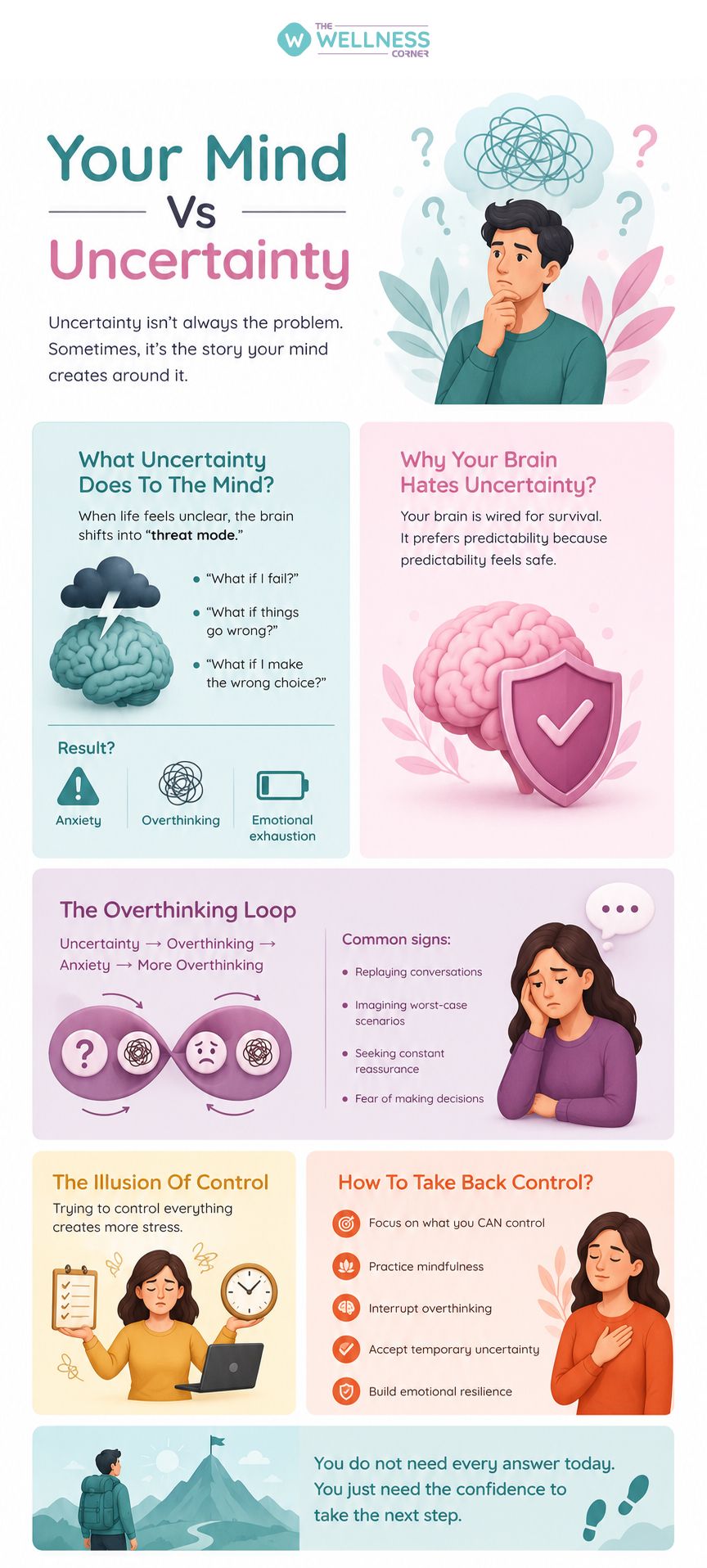
Why The Human Mind Struggles With Uncertainty?
The human brain is naturally wired to anticipate potential risks and keep us safe. For thousands of years, survival depended on our ability to detect threats and anticipate danger.
Because of this, the brain naturally prefers certainty. When situations feel predictable, the brain relaxes. When things feel unclear or unpredictable, the brain switches into alert mode.
This response was useful when humans needed to avoid physical dangers. However, in modern life, this same mechanism often reacts to everyday uncertainties such as career decisions, relationships, finances, or health concerns.
Instead of real threats, the brain begins reacting to imagined possibilities.
For example:
- “What if this project fails?”
- “What if I make the wrong decision?”
- “What if things don’t work out?”
These thoughts create a cycle where uncertainty leads to overthinking, and overthinking increases anxiety.

The Illusion Of Control
Many people try to eliminate uncertainty by controlling every possible outcome. They plan every detail, analyze every option, and constantly prepare for potential problems.
While planning can be helpful, the desire for complete control can quickly become exhausting.
No matter how much we plan, life will always contain unknown variables.
Flights get delayed. Business strategies change. Relationships evolve. Health situations shift. Even carefully designed plans can take unexpected turns.
Trying to control every possible outcome is like trying to control the weather. It creates unnecessary stress and often leads to disappointment.
True peace comes not from controlling everything, but from learning how to respond calmly when things change.
Also Read: Psychology Hacks You Should Know To Control Any Situation
How Overthinking Makes Uncertainty Worse?
When faced with uncertainty, many people fall into the trap of overthinking.
Instead of focusing on the present moment, the mind jumps ahead to multiple possible futures. Some of these possibilities may never happen, yet they begin to feel real because we keep replaying them in our minds.
Overthinking often looks like this:
- Replaying conversations repeatedly
- Analyzing every possible decision outcome
- Imagining worst-case scenarios
- Seeking constant reassurance
- Struggling to take action due to fear of making mistakes
The more the mind tries to solve uncertainty by thinking harder, the more tangled the thoughts become.
This mental loop drains energy and makes simple decisions feel overwhelming.

The Power Of Shifting Your Perspective
One of the most effective ways to deal with uncertainty is to change how you view it.
Instead of seeing uncertainty as a threat, try seeing it as a possibility.
Uncertainty means that the future has not been decided yet. That space contains both challenges and opportunities.
Many of life’s most meaningful moments began with uncertainty:
- Starting a new job
- Moving to a new city
- Beginning a relationship
- Trying something unfamiliar
- Pursuing a new idea
If everything in life were predictable, growth would be impossible.
Learning to stay open to uncertainty allows curiosity to replace fear.
Practical Ways To Regain Mental Control
While uncertainty cannot be eliminated, you can train your mind to handle it more calmly. Here are several strategies that can help.
1. Focus On What You Can Control
You may not control every outcome, but you can control your actions.
Focus on small, manageable steps you can take today instead of worrying about distant possibilities. Taking action builds confidence and reduces mental clutter.
Also Read: De-Clutter Your Life!
2. Limit The Overthinking Loop
If you notice yourself stuck in endless analysis, pause and redirect your attention. Write your thoughts down, take a walk, or engage in a task that requires focus.
Creating distance from the thought spiral helps the mind reset.
3. Accept That Some Questions Have No Immediate Answers
Not every situation will provide instant clarity. Sometimes the healthiest response is allowing time to reveal the next step.
Accepting temporary uncertainty reduces unnecessary stress.

4. Practice Mindfulness
Mindfulness helps bring attention back to the present moment instead of constantly jumping into future scenarios.
Simple practices such as deep breathing, meditation, or body awareness can calm the nervous system and improve emotional balance.
5. Strengthen Emotional Resilience
Resilience does not mean avoiding uncertainty. It involves having confidence in your capacity to deal with whatever the future brings.
Every challenge you have overcome in the past proves that you are capable of navigating difficult moments.
Why Emotional Awareness Matters?
Uncertainty often brings emotions such as anxiety, frustration, and self-doubt. Ignoring these emotions can make them stronger over time.
Recognizing and acknowledging your feelings allows you to process them in a healthy way.
Talking to someone you trust, journaling your thoughts, or seeking professional guidance can help bring clarity to overwhelming situations.
Emotional awareness does not eliminate uncertainty, but it makes it easier to move forward without feeling stuck.
Also Read: Dealing With Frustration!
A Smarter Way To Strengthen Your Mental Wellbeing
Managing uncertainty is not something people should have to handle alone. Building mental resilience often requires the right support systems, tools, and guidance.
This is where digital wellness platforms are making a meaningful difference.
The Wellness Corner, offered by Truworth Wellness, provides employees and individuals with access to mental health resources designed to support emotional well-being in everyday life.
Through the platform, users can explore:
- Mental health self-assessments
- Guided mindfulness sessions
- Stress and anxiety management tools
- Expert consultations with psychologists and wellness coaches
- Emotional wellness articles and practical coping strategies
These resources help individuals better understand their thoughts, manage uncertainty more effectively, and build healthier emotional habits over time.
Final Thoughts: You Don’t Need All The Answers
Uncertainty is not a flaw in life’s design. It is part of what makes growth, discovery, and new opportunities possible.
Your mind may try to convince you that everything needs to be figured out immediately. But the truth is, clarity often arrives step by step.
You do not need to control every outcome to move forward.
Sometimes the most powerful choice is simply trusting yourself enough to take the next step, even when the entire path is not visible yet.
The future will always contain unknowns. What truly matters is how calmly and confidently you choose to face them.
Also Read: Struggling To Make A Big Decision? Here’s Why-And How To Find Clarity?
Common Questions About Managing Uncertainty
1. Why does uncertainty make people anxious?
Uncertainty activates the brain’s threat detection system. When the future feels unpredictable, the mind tries to anticipate risks, which can trigger anxiety and overthinking.
2. Can uncertainty ever be beneficial?
Yes. Uncertainty often creates opportunities for growth, creativity, and new experiences. Many positive life changes begin with situations that initially feel unclear.
3. How can I stop overthinking uncertain situations?
Focus on actions you can control, limit repetitive thinking, and practice mindfulness techniques such as deep breathing or journaling to clear mental clutter.
4. When should someone seek professional support for anxiety?
If uncertainty is causing constant worry, sleep issues, difficulty concentrating, or affecting daily functioning, speaking with a mental health professional can be
helpful.
5. Are digital wellness platforms effective for mental health support?
Yes. Platforms like The Wellness Corner provide accessible tools, expert guidance, and self-care resources that help individuals manage stress, anxiety, and emotional challenges more effectively.
Leave a Comment

Sign-Up Now & Unlock
₹100 Cashback
Recently Published
Related Articles




Health Checks @ Home
Service
Explore



Follow us on:


© 2026 Truworth Health Technologies Pvt. Ltd.