Why Do We Keep Making Excuses For People Who Hurt Us?
2 days ago
6 minute read.
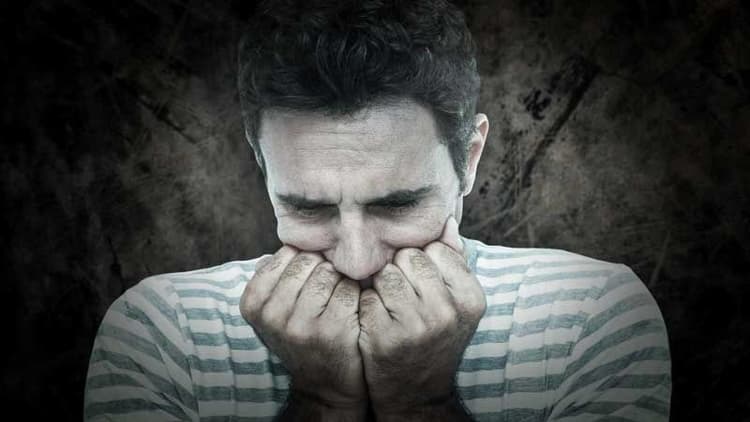
Have you ever found yourself justifying someone’s behavior, even when you knew deep down that what they did was wrong? Maybe they ignored your feelings, betrayed your trust, or repeatedly let you down. And yet, instead of drawing a line, you said things like:
- “They were just stressed.”
- “They didn’t mean to hurt me.”
- “They’re going through a lot right now.”
If this sounds familiar, you’re not alone. Many of us have been there-caught in a painful loop of excuses, hoping things will change. But why do we do it? Why do we protect, defend, and hold space for people who keep hurting us?
Let’s dig into the emotional and psychological reasons behind this common behavior.
Also Read: Astonishing Psychological Facts About Human Behaviour
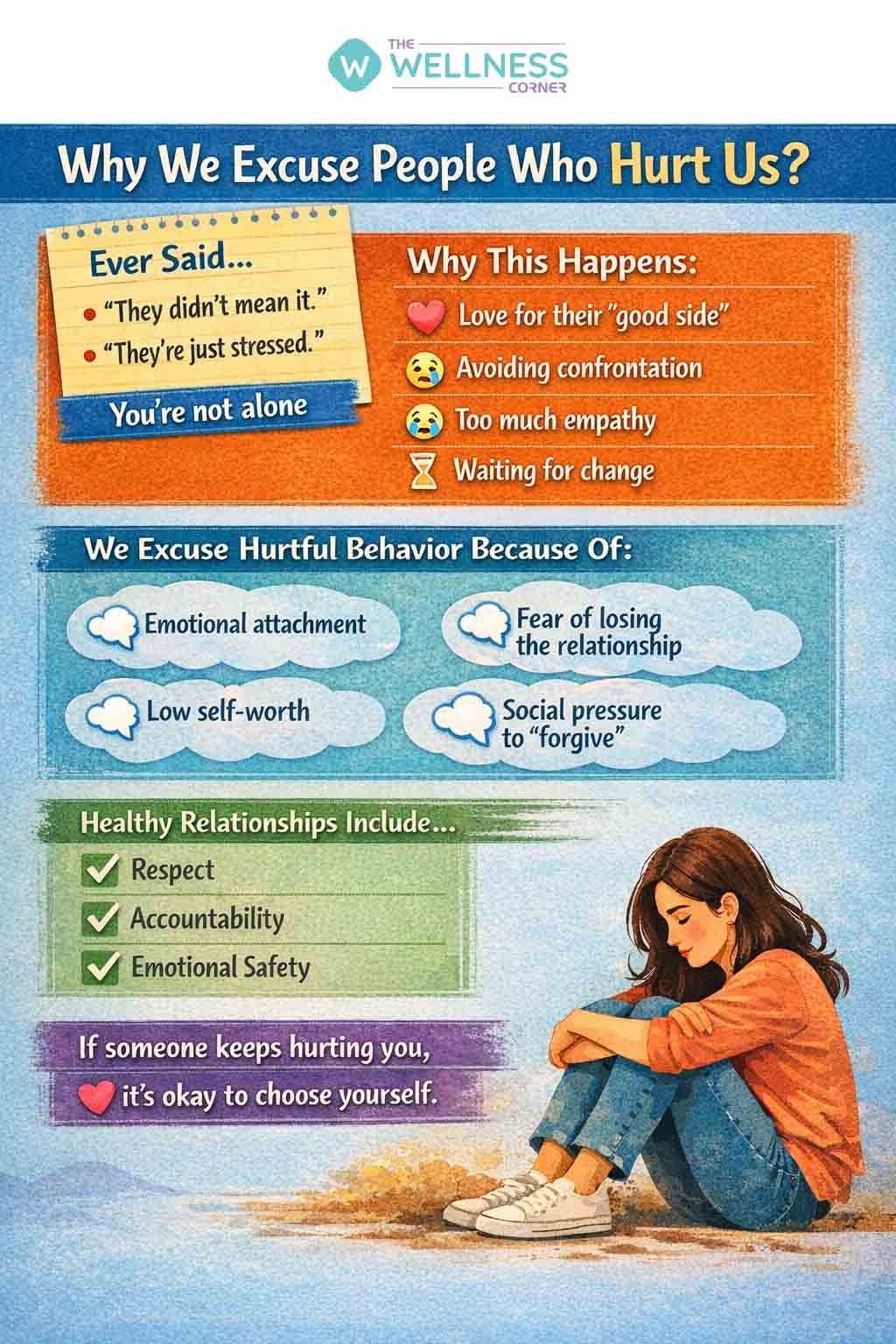
1. We Want To Believe In The Good In People
Sometimes we fall in love with someone's potential instead of their reality. We remember the version of them that once made us feel valued-maybe they were kind in the beginning, or there were good times that stood out. So even when they hurt us now, we hold onto hope that those “better days” will return.
We tell ourselves, “They’re not always like this,” or “They didn’t mean to hurt me,” because it's easier to cling to the idea of who they could be than to face who they are now.
It’s hard to let go of a version of someone that once felt like home.

2. Fear Of Confrontation Or Conflict
For many of us, confrontation is uncomfortable. It causes tension, discomfort, and the possibility of harming the relationship. So instead of addressing hurtful behavior, we rationalize it.
We say, “It’s not worth the fight,” or “I’ll just let it go this time.”
But when it happens again-and again-the resentment grows.
In truth, avoiding conflict doesn’t preserve peace. It just postpones the explosion.
Also Read: Relationship Strengthening Conversations Every Couple Needs To Have
3. Low Self-Esteem Or Self-Worth
When we don’t believe we deserve better, we accept less. This is one of the most heartbreaking realities. If someone constantly disrespects your boundaries or belittles your feelings, and you still make excuses for them, ask yourself:
“Why do I think this is okay?”
People with low self-worth often internalize blame:
“They treat me this way because I’m too much.”
No.
You’re not too much. You’re not difficult. You're simply in a situation where your worth is not being recognized.

4. We’re Emotionally Attached Or Trauma Bonded
When someone repeatedly hurts us but also gives us moments of love, attention, or affection in between, it creates confusion. The push-and-pull dynamic is known as trauma bonding. It keeps us emotionally hooked, even when we know we’re being hurt.
You begin to crave their approval, their “good” side, the moments when things feel okay again. This emotional rollercoaster is exhausting, and dangerous.
We excuse the bad because we’re chasing the high of the good.
Also Read: Trauma Bonding: Signs You’re Trauma Bonded
5. We’re Empathetic And Over-Understanding
Empathy is a beautiful trait-but when it turns into over-empathy, it can become self-destructive.
We excuse others’ behavior because “they’ve had a tough childhood” or “they’re going through something.” And while compassion matters, it should never come at the cost of your own well-being.
Understanding someone’s pain doesn’t mean you have to tolerate their hurtful behavior.

6. Hope That They’ll Change
One of the most powerful traps is hope.
You keep thinking, “Maybe next time things will be different.” You see small improvements and think it’s a sign that they’re changing. But real, lasting change requires effort, self-awareness, and accountability.
Waiting for someone to change can steal years from your life if they’re not actually working on themselves.
7. Social And Cultural Conditioning
Many of us grow up with the idea that we should always forgive, be kind, and put others first-especially in families or relationships. We're told:
- “Don’t make a big deal out of it.”
- “It’s your duty to maintain peace.”
- “Blood is thicker than water.”
So even when someone repeatedly causes pain, we feel guilty for setting boundaries or walking away. Especially in cultures that stress family honor, loyalty, or obedience, standing up for yourself may be wrongly seen as selfish or rebellious.

8. We’re Afraid Of Being Alone
Loneliness is powerful. Sometimes, we’d rather be with someone who treats us poorly than face the silence of being alone. We convince ourselves that “some love is better than no love.” But that isn’t true.
Being alone may feel uncomfortable at first-but it also gives you space to heal, grow, and rediscover your worth. Staying in unhealthy dynamics only delays that process.
Also Read: 5 Signs Your Body And Mind Need 'Alone Time'
9. Normalizing Unhealthy Behavior
If we grew up seeing dysfunction-like yelling, criticism, neglect, or emotional manipulation-we may unconsciously believe that’s just how relationships are. So when someone treats us poorly, we don’t always recognize it as abuse or toxicity.
We may even think: “This is just how people are,” or “Maybe I’m too sensitive.”
If you constantly feel drained, anxious, or on edge around someone-it’s not healthy.
So… How Do We Break The Cycle?
Awareness is the first step. Once you recognize the pattern, you can choose differently. Here are a few ways to start healing:
- Pay attention to actions, not just words.
Apologies without change are manipulation.
- Stop minimizing your pain.
Your emotions are legitimate, even if others try to dismiss them.
- Practice self-compassion.
Be kind to yourself. You’re allowed to walk away from hurt—even if you love the person.
- Set boundaries.
Boundaries aren’t punishments, they’re protection.
- Talk to someone.
A therapist, friend, or support group can help you untangle your thoughts and build clarity.
- Don’t be afraid to choose yourself.
Sometimes the hardest thing is also the most loving thing you can do, for you.
Final Words
It’s easy to make excuses for someone when your heart is involved.
It’s hard to hold them accountable when you care so deeply.
But here’s what you need to remember:
You deserve relationships where love doesn’t come with pain.
You deserve people who take responsibility-not just for their actions, but for how those actions make you feel.
You deserve peace.
Stop explaining away the hurt.
Start listening to the part of you that’s asking for more.
Frequently Asked Questions (FAQs)
1. Why do people make excuses for someone who hurts them?
Many people justify hurtful behavior because of emotional attachment, hope for change, fear of conflict, or a desire to preserve the relationship. Sometimes empathy and past memories of good moments make it harder to acknowledge the harm.
2. What is trauma bonding?
Trauma bonding occurs when a person experiences cycles of hurt followed by moments of affection or kindness. This emotional push and pull can create a strong attachment that makes it difficult to leave unhealthy relationships.
3. How can I tell if I’m ignoring unhealthy behavior?
If you often feel anxious, drained, or constantly justify someone’s actions despite feeling hurt, it may be a sign that the relationship is affecting your emotional well-being.
4. Is setting boundaries selfish?
No. Boundaries are a healthy way to protect your emotional and mental health. They help define what behavior you are willing to accept in a relationship.
5. When should someone seek support for relationship struggles?
If a relationship repeatedly causes emotional distress, confusion, or affects your self-worth, talking to a trusted friend, counselor, or mental health professional can provide clarity and guidance.
Leave a Comment

Sign-Up Now & Unlock
₹100 Cashback
Recently Published
Related Articles



Health Checks @ Home
Service
Explore



Follow us on:


© 2026 Truworth Health Technologies Pvt. Ltd.